2025
64”x36”x24”
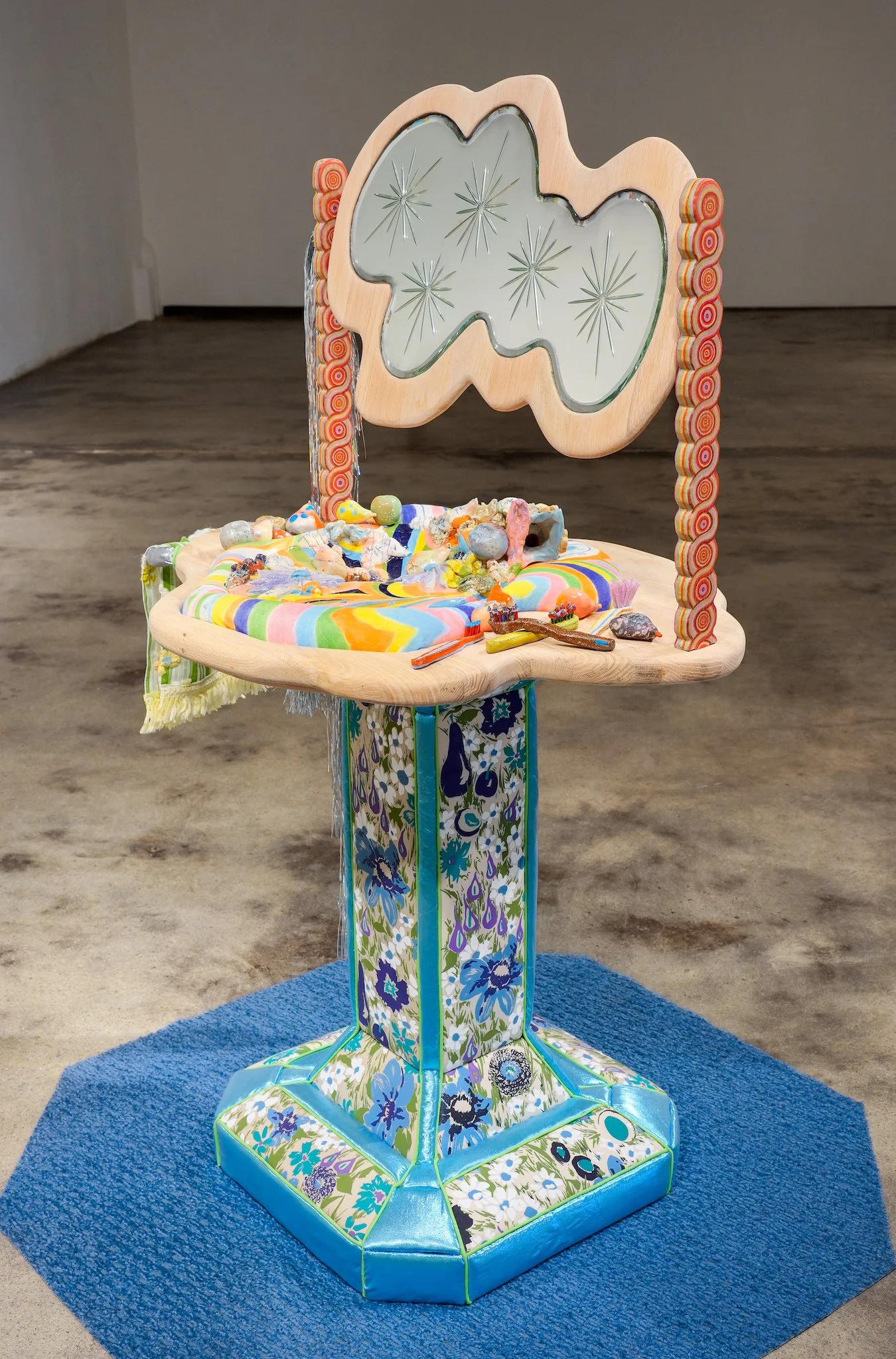
Repurposed oak side table, radiant cut and beveled glass, mirror silvering, colored pencil, upholstery foam, batting, screen printed fabric (print based on fruits and flowers classified as “unfit” in Luther Burbank’s photographic archive. 8 layer repeat print from hand painted original in 1970’s style), colored pencil on ink sensitive linen fabric, slipcast ceramic from fruits gathered from Sonoma State Hospital’s historic orchard, underglazed stoneware, lame’ fabric, glass beads, tinsel, flocking, glow in the dark paint, sequins, wood armature.
I think of this object as the wash basin that would exist in the reimagined hospital orchard. The mirror is cut glass that I silvered to create the reflective surface. When I visited Luther Burbank's estate, I saw it was adorned with Victorian era cut glass. When thinking about dismantling the hospital grounds or Burbank's research grounds and taking back the orchard, I imagined repurposing the starburst cut glass and turning it into mirrors that reflect our own radiance. The form of the vanity mirror indicates that it was built for multiple people to be reflected at once, with five starbursts cut into it. There are four toothbrushes beside the ceramic bowl, representing a loss. The fabric on the pedestal is an eight layer screen print that I originally hand painted to evoke a 1960’s/70’s style.
When I imagine what I really want, I just want to wake up and brush my teeth and wash my face with you. You as in my trans neurodiverse partner, my mad and dead brother, all the friends and family who have died because they didn’t receive the care they need, all the people still here who deserve to rest and some sweetness. I want us (the “people of the orchard”/myself and other people living with external and internalized stigma for our trans/mad/neurodivergent/non-normative bodies) to exist, as we are. I want us to see ourselves and each other as radiant, to feel connected, and to enjoy the sweet pleasures in life while participating in the mundane tasks of existing. I want it to be a more commonplace experience for us to be known and loved and cared for.
Photographs by Hadley Raysor Photography
2025
30”x14”x12”
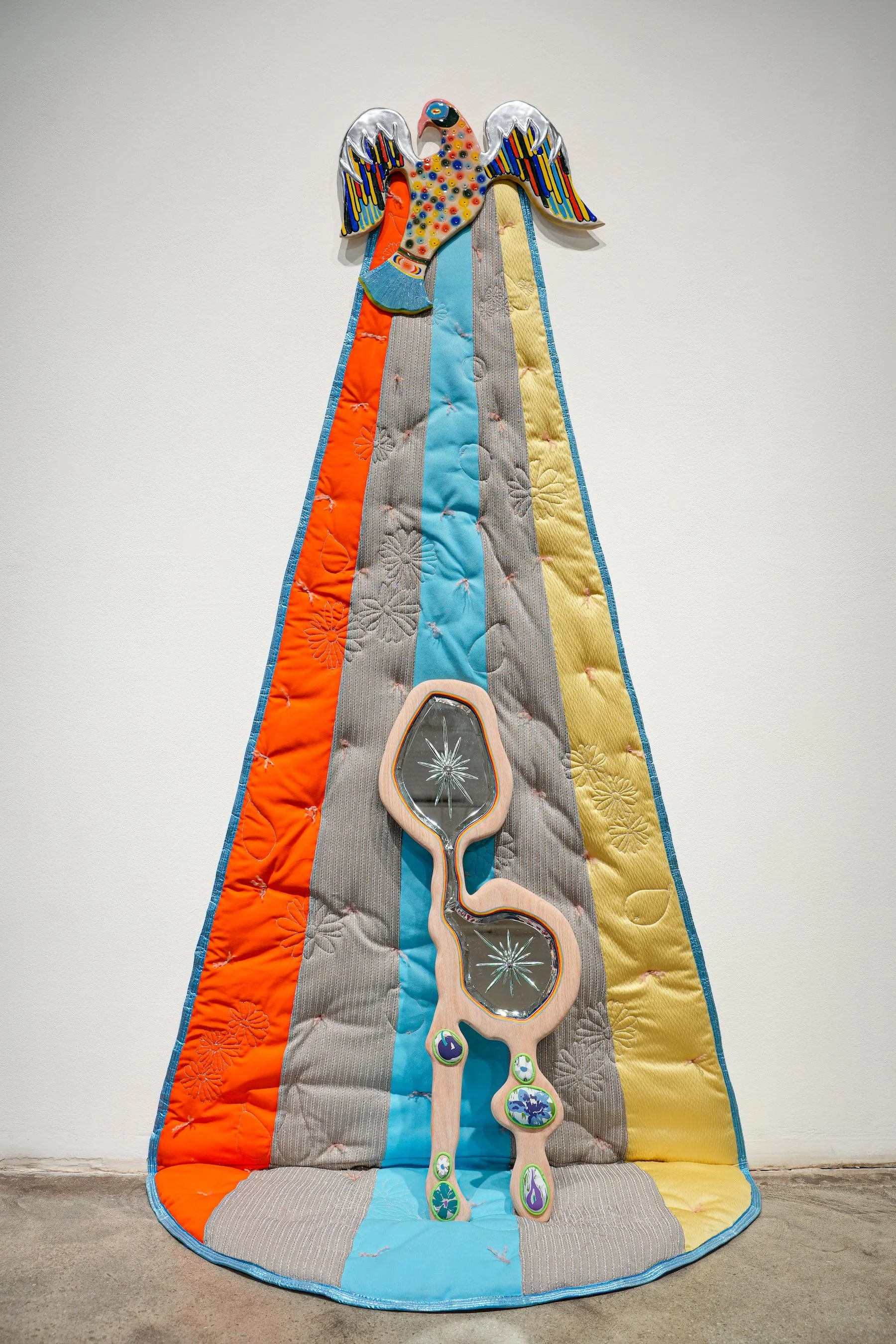
Repurposed oak side table, radiant cut and beveled glass, mirror silvering, colored pencil, upholstery foam, batting, screen printed fabric (print based on fruits and flowers classified as “unfit” in Luther Burbank’s photographic archive), underglazed stoneware, quilted and embroidered found fabrics
This work touches on themes of protection, ghosts/ancestors, and the experience of mutual recognition between trans/gender variant and mad/neurodiverse people - or anyone who experiences living in a non-normative body. It's an altar to protect our ability/means to know who we are, and be surrounded in soft spaces to recognize our radiance, together.
The two-person hand held mirror sits on top a quilted fabric stitched together with silver embroidery that was created by tracing a collection of Luther Burbank's photographic records of fruits and flowers he deemed "unfit".
Photographs by Hadley Raysor Photography
Furniture for Hospital Orchards
2023
Dimensions vary
Hand painted, digitally printed, quilted, and woven fabrics, upholstery materials, aluminum tubing, wood armature, slipcast ceramic and plaster cast fruits gathered from Sonoma State Hospital’s historic orchard, carpet, audio of my partner Hadley humming a soothing and haunting song, tinsel. The privacy curtain is a quilted digital print on linen with a collage of fruits and flowers from Luther Burbank’s photographic records of plants that he deemed “unfit” for reproduction.
Furniture for Hospital Orchards imagines an alternative time and space for queer, trans, disabled, and immigrant people who were committed to Sonoma State Hospital, an institution that implemented forced sterilization from 1909–1979. This series connects to my personal family lineage as well as a collective Bay Area trans/gender variant, queer, mad and neurodiverse ancestry by imagining a world where those forced to labor in state hospitals, specifically in the hospital’s orchard, could redirect their energy towards their own rest, healing, and pleasure. By highlighting parallels between historic horticultural practices and the forced sterilization movement in the Bay Area, the work challenges eugenics informed constructs of what it means to be “normal” and celebrates the variance that eugenics attempts to erase.
2023
14.5’ x 5’ x 8”
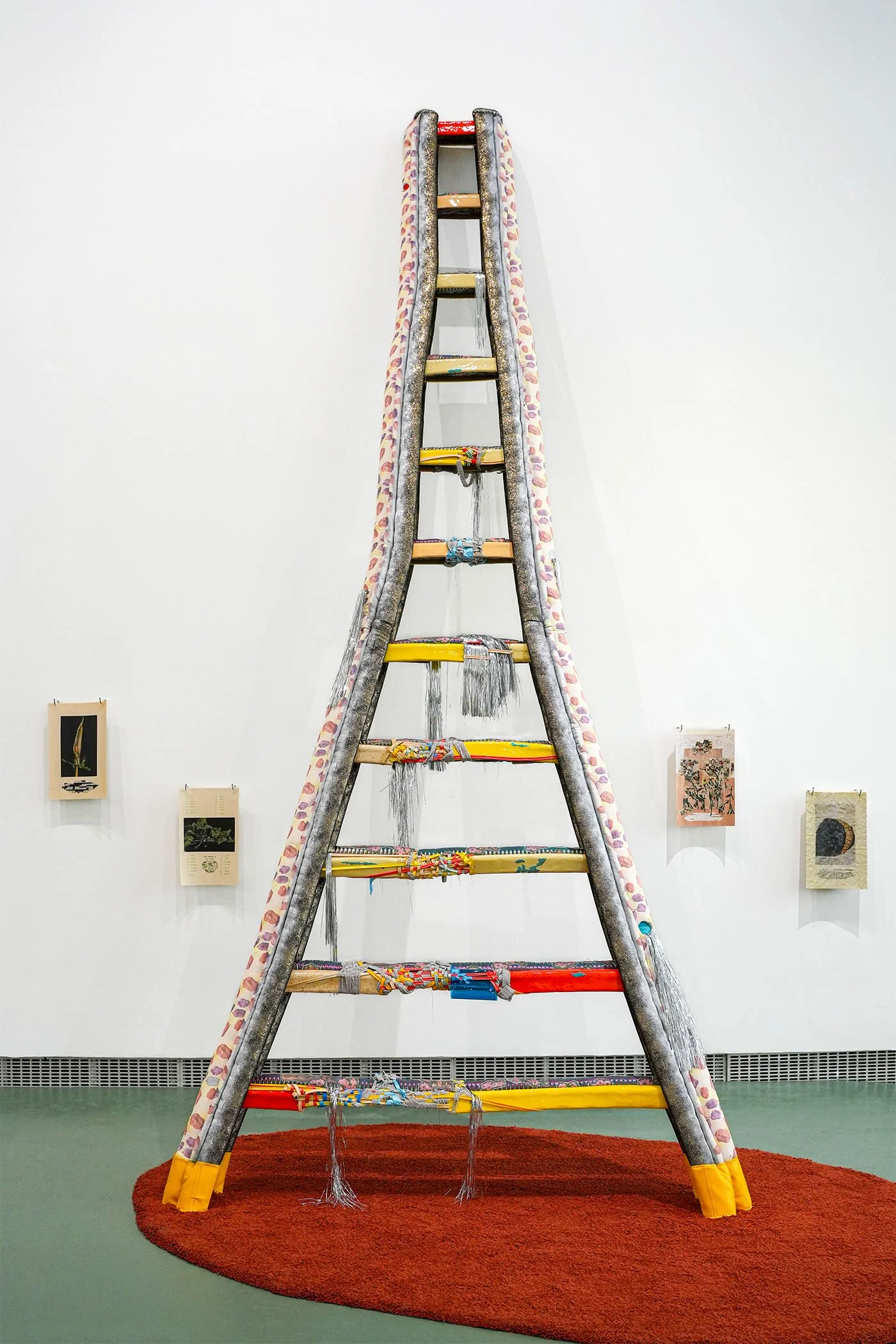
Quilted digital prints on linen and silk with collaged fruits and flowers from Luther Burbank’s photographic records of plants that he deemed “unfit” for reproduction, recycled upholstery materials, glazed stoneware, carpet, found fabrics, spray paint, spray painted vinyl and fabric strap weavings, tinsel, wood armature
14 foot orchard ladder with ceramic ladder slats and digitally printed quilted fabrics with collaged patterns of fruits and flowers from Luther Burbank’s photographic records of plants that he deemed “unfit” for reproduction. Each ceramic ladder slat is imprinted with fruits pressed into the clay that were gathered from Sonoma State Hospital’s historic orchard. The broken ceramic steps are woven together with spray painted vinyl and fabric straps.
Another Use for Language
2023
17” x 24” digital prints
Poetry and collage contributions from Jari Bradley, Laura Woltag, Laurel Sewhere, Maria Silk, Mason J., and Tatiana Luboviski-Acosta.
2000 free take-away posters hung on the wall and were distributed as a part of my installation for Bay Area Now 9. I worked with YBCA to commission six new poems from Bay Area trans and gender non conforming poets, writers, and artists. Each person was invited to physically mark/edit a page from Luther Burbank’s volumes on plant hybridization and create a new piece of writing inspired by the revisions they made. The poems were typed onto the back side of the posters.
2022
Digital video, 8:04
Directed by Nicole Shaffer, Director of Photography Chani Bockwinkle
Evolving work in progress/living archive of queer and trans swimmers and bathers as they transition in and out of Bay Area bodies of water.
During the period of the pandemic when I was experiencing extended isolation, I started open water swimming. It felt urgent and necessary to show up for the sensory feedback of being held by the water, the structured time for checking in and being a body with other queer and trans friends, and noticing wisdom in the elder swimmers’ unique choreographies as they prepared to enter an extreme phenomenal experience. My art practice continues to be concerned with ideas and practices around buoyancy and bridging access to uplifting forces of support.
Thank you swimmers and bathers, Heesoo Kwon, Laura Woltag, Sarah Mehl, Linds Adams, Lindell Dixon, Zarina Dixon, and Rose Rodriguez
Buoyancy
2022
Site-oriented installation at 500 Capp St.
This piece was shown as a part of Libby Black’s solo exhibition titled The Way Things Also Are at 500 Capp Steet, with featured artists AJ Serrano, Sanaz Safanassab and myself. The show made space for queer conversations and interventions within the former home of conceptual artist, David Ireland.
I projected my film of TGNC and queer swimmers + bathers onto the ceiling of the David Ireland house by strapping a projector to the banister with a custom made harness. The harness is made out of floral printed fabrics that artist Maura O’Daughrty and I created from photos of plants that were deemed “unfit” by 20th century Petaluma horticulturist, Luther Burbank. I came across these photos while researching the relationship between Bay Area horticultural practices and the forced sterilization of queer, trans, neurodivergent, and immigrant people in California during the first half of the 20th century. I’ve been using the fabrics to upholster a number of sculptures that celebrate the variance that eugenics attempts to erase.
Visitors to the house were directed to look up towards embodied queer and trans pleasure, joy, and power.
2022
dimensions vary
Four sculptures are staged to create an analog projection onto a custom scrim. The work references home furnishings and is inspired by growing up with my father who organized the apartment we lived in together in non-normative ways. For him, object staging was a mystical practice that involved visions and communications that were beyond consensus reality. In the installation, diagrams are abstracted, a sculpture creates projections, and household objects align in oracular fashion.The project takes visual language from Enlightenment era Rational aesthetics, such as mystical diagrams, a mad mathematician's geometric schematics, and CA seismographic data and converts their claims of coherence into an abstracted and poetic experience.
2022
4’x5’
Carpet remnant, vintage yarn, latch hooked infographic, 3 pennies, one hair tie, yellow book.
This piece was shown as a component in a larger installation. Four sculptures are staged to create an analog projection onto a custom scrim. The work references home furnishings and is inspired by growing up with my father who organized the apartment we lived in together in non-normative ways. For him, object staging was a mystical practice that involved visions and communications that were beyond consensus reality.
2022
40”x.25”x40”
Transparent acrylic sheets, rattan, glass and plastic beads, woven rex-lace and fishing line, yellow flocking, nail polish, custom printed velour fabric with one hour of CA seismographic data
Polar-Opposite Forms of the Third Ground
2022
30”x30”x65”
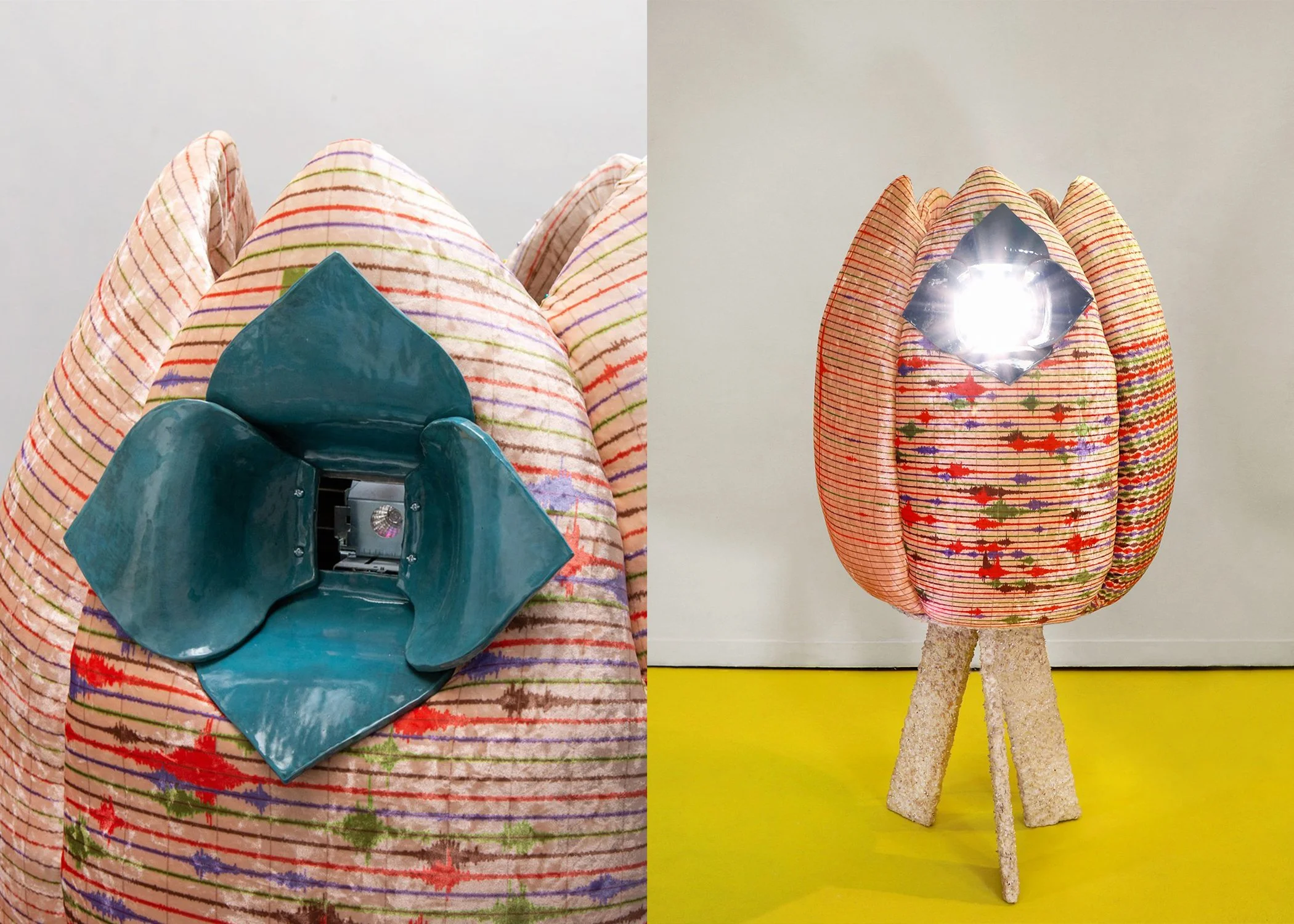
Deconstructed projector, fan, custom printed velour fabric with 5 days of CA seismographic data. The form is modeled from Benjamin Brett’s schematics of “The horn-shaped onde corolla” as delineated in his book, Geometrical Psychology, or, The Science of Representation. Paper mache, wood, pearlite, and mica stand
Each panel of this sculpture is upholstered with a printed fabric that depicts a unique 24 hour period of CA seismic activity. The surface of the sculpture indicates the existence of earthquakes, legible to the viewer only through the visual representation of seismographic data - an aesthetic language that says more about the desire to predict and contain the earthquake than it does about the phenomenal experience itself. The sculpture is component of an installation titled, “Like Luck”, in which visual language from Enlightenment era Rational aesthetics, such as mystical diagrams, a mad mathematician's geometric schematics, and CA seismographic data, and converts their claims of coherence into an abstracted and poetic experience.
2022
36”x26”x46”
Repurposed mattress, ceramic step stool and ceiling tile, orange velvet, mobility handles, rainbow catcher, mylar streamers, cotton piping, mirror, custom printed velour fabric with altered photo from the archives of Luther Burbank
I used crafting techniques taught to me by my mother to make a furniture-like object customized to support my body in a position that offered relief and also possibly aggravation to my back injury.
My mom's child body
2019
90” x 60”
Acacia pollen, photocopies, and archival inkjet print documenting a site-oriented installation at the former apartment unit of a child trafficker.
This project was the culmination of research into family history and the botanical landscape of an Oakland neighborhood.
2019
25’ x 25’
Recycled building materials and home furnishings
Sculptures that reference objects used for somatic therapies such as massage tables, physical therapy equipment, and visual references to new age healing products are integrated into a false floor that repositions familiar orientations and encourages vantage points that reveal the structural foundation of the space. A guided meditation placing the listener at a far away location plays softly.
The installation draws inspiration from the book Queer Phenomenology, by Sara Ahmed.
2014
Salt, roses, carpet. Installation in the apartment I grew up in with my father created the week before he left it.
2013
Threaded thistle seed carriers strung in bathroom over the course of three months.
2005
Site-specific installation, c-print
Sand, artificial poppies, beach umbrella, family.
I made this when I was 19. It’s a beach for my mom and my family. I brought truckloads of sand to a place where I used to hang out as a teenager. I got permission from the Port of Oakland to do it?! It’s one of first things I made that I felt like showing to people..